Rugby terms can seem complicated, but understanding the main ones makes it easier to follow a match.
Ad
Learn the most commonly used expressions and better understand what happens on the field.
Scrum: Understand How this Formation Works in Rugby

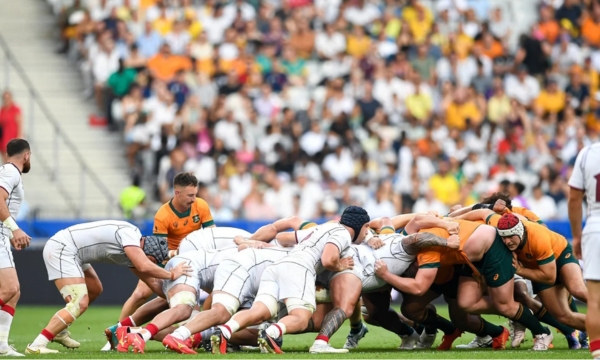
If there is one classic image of rugby, it is the scrum, used to restart play and contest possession of the ball.
In 15 a side rugby, eight players from each team form the structure.
The scrum-half feeds the ball in, while the players seek to maintain the formation and move forward.
What should you watch during the scrum?
- Formation of the players from each team.
- Ball entry by the scrum-half.
- Contest for possession.
- Movement of the formation forward.
- Ball coming out to continue the play.
So, when the commentator says that a team won the scrum, it means that team maintained or gained possession.
It is practically an organized battle of strength, technique, and coordination!
Lineout: Learn How this Contest for the Ball Works
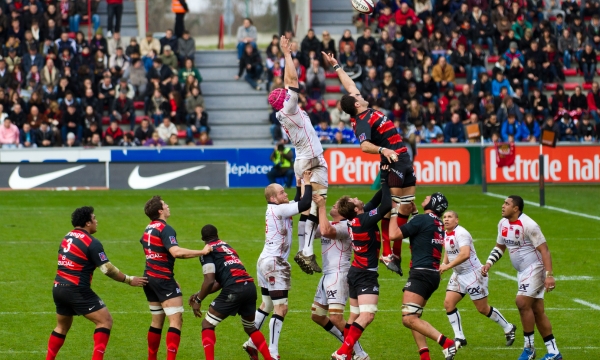
Another one of the rugby terms you will hear a lot is lineout.
It happens when the ball goes out over the sideline and play needs to be restarted.
Players from both teams form lines near the sideline, while one player throws the ball into the middle of the formation.
That is when one of the coolest scenes in rugby begins.
In the lineout, you can watch:
- Throwing the ball from the sideline.
- Players jumping to contest possession.
- Teammates helping with the jump.
- Attempts to regain the ball.
- Formation of a maul after the reception.
So, when someone mentions a lineout, you already know you are watching an aerial contest for possession.
Try: Understand the Main Way to Score Points
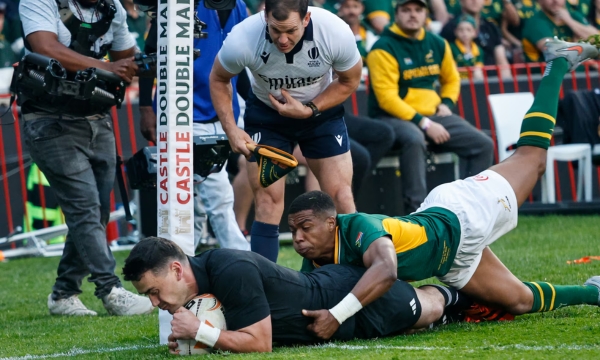
Among rugby terms, perhaps try is the most important one for beginners.
It is the main way to score points in rugby: it is worth five points.
A try happens when the player grounds the ball in the opposing in-goal area, according to the rules.
There are also other ways to score:
| Scoring method | Value |
|---|---|
| Try | 5 points |
| Conversion | 2 points |
| Penalty try | 7 points |
| Converted penalty | 3 points |
| Drop-goal | 3 points |
When you hear the commentator shout “TRY!”, you already know why the crowd is celebrating.
Ruck: Learn about this Contest for Possession of the Ball
The ruck appears frequently during a match and is one of the important rugby terms.
It happens when players contest the ball on the ground.
Teammates try to protect possession, while opponents seek to regain it.
Players arriving must remain on their feet and enter correctly, respecting the rules of the formation.
In practice, watch:
- Who arrived first.
- Which team manages to protect the ball.
- Whether the players remain on their feet.
- Which side possession comes out to.
The ruck can last just a few seconds, but it is essential for keeping the game moving.
Maul: Discover How this Play Happens in Rugby
The maul resembles the ruck, but there is an important difference: the ball remains with a player who is standing.
Teammates join the formation and help move forward with possession.
This play appears frequently near the try line, when the team tries to gain ground.
Ruck x Maul
| Situation | Ruck | Maul |
|---|---|---|
| Ball | Is on the ground | Remains with a player |
| Players | Remain standing | Remain standing |
| Contact | Around the ball | Around the ball carrier |
| Objective | Contest possession | Advance and maintain possession |
This difference is small in theory, but makes all the difference during the broadcast.
Terms Used by Commentators during Matches
Now we have reached the part that can make you feel much more comfortable watching a match.
Some rugby terms appear all the time during broadcasts.
Here are some of the most common:
- Tackle: the action of holding the ball carrier and bringing them to the ground.
- Offside: a situation in which a player is in an illegal position and cannot participate in the play.
- Advantage: when the referee allows play to continue after an infringement because the opposing team is gaining a real advantage.
- Knock forward: when the ball is lost or touched forward and is not immediately recovered by the player.
- Penalty: a penalty awarded after an infringement.
- Drop-goal: a kick during open play that passes between the posts and over the crossbar, worth three points.
One important note: World Rugby has updated some official terms in recent years.
Other Rugby Expressions that Appear during Games
In addition to the main rugby terms, there are other words that help you follow what happens on the field.
You do not need to memorize them all at once.
Start with the most frequent ones:
Scrum-half
This is the player who normally connects the forwards with the backs and takes part in distributing the ball.
Fly-half
They usually play an important role in organizing attacking plays and making attacking decisions.
Forward
These are the players most involved in physical contests, such as scrums, rucks, and lineouts.
Back
Players who normally operate farther away from the formations and can exploit spaces with speed.
In-goal
In rugby terms, this is the area beyond the try line where the ball must be grounded to score.
How these Terms Help You Understand Rugby Better

Now that you know the main rugby terms, watching a match becomes much more interesting.
A scrum shows an organized contest for possession. A lineout presents a battle in the air.
A ruck indicates a contest for the ball on the ground. A maul shows a team trying to advance while maintaining possession.
And a try? Well, you will probably celebrate that one along with the crowd!
Knowing these terms also helps you better understand the referee’s decisions.
Little by little, what seemed like a chaotic sequence starts to make sense.
And, to watch more matches, the RugbyPass app can also be an option.
That way, you can put your knowledge into practice and recognize the terms during games.
Conclusion: Now You Can Follow a Match!
You do not need to learn everything at once!
Start with scrum, lineout, try, ruck, and maul, and gradually learn new expressions.
With more matches, recognizing each situation becomes more natural.
Soon, understanding rugby terms will make that commentator speaking quickly seem much less complicated.